0800 233 724 (toll-free)
 enquiries@online.cut.ac.za


The contemporary digital economy is defined by a paradox of connectivity. While rapid technological integration has unlocked immense opportunities for economic growth across the African continent, it has simultaneously expanded the attack surface to an unprecedented degree. As the traditional network perimeter dissolves under the pressure of mobile banking and cloud-native services, the imperative for robust threat detection in cybersecurity systems has never been more critical.
Evolution of the Architecture of Defence
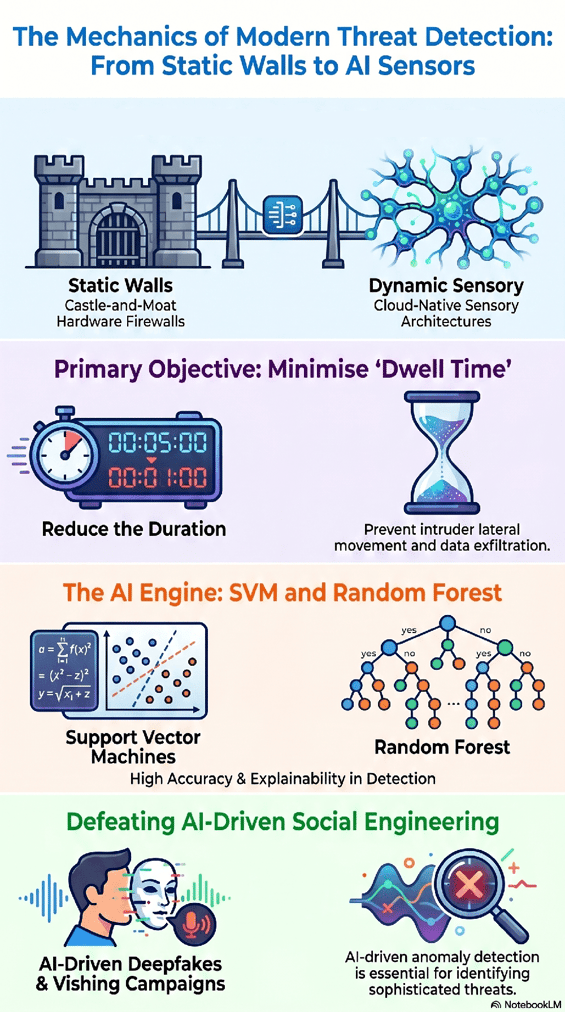
The historical shift in cybersecurity strategy has moved from hardware-based firewalls to intelligent, cloud-native security frameworks. Modern systems function less like a static wall and more like a biological sensory system, designed to identify and respond to unauthorised activity in real-time. This is explored further in the section on threat detection in a previous article.
The primary objective of threat detection and response is the minimisation of "dwell time", which is the duration an intruder remains undetected. This is achieved through a layered approach incorporating the SOC Visibility Triad of Endpoint Detection and Response (EDR), Network Detection and Response (NDR), and Security Information and Event Management (SIEM).
Technical Foundations: Mechanics of Detection
At the foundational level lies signature-based detection. This method identifies known malicious patterns, or "fingerprints", by comparing observed data against a database of documented threats. While remarkably effective for identifying commodity malware with high precision and low computational overhead, it is ineffective against zero-day exploits.
To address these gaps, the industry has shifted from signature detection to behavioural analysis. Instead of inspecting a file to see if it is malicious, it looks at the processes being run to identify malicious activity. By establishing a baseline for "normal" activity, such as typical login times or file access patterns, systems can flag deviations that reveal insider threats or polymorphic malware. Detailed comparisons of these methods can be found in our section on how threat detection works in a previous article.
The Role of Artificial Intelligence
The integration of Artificial Intelligence (AI) and Machine Learning (ML) represents the current frontier of digital defence. Modern security platforms leverage Support Vector Machines (SVM) and Random Forest algorithms to enhance intrusion detection, offering both high accuracy and "explainability" for analysts. Furthermore, AI-driven anomaly detection is increasingly vital to combat deepfake impersonations and vishing (voice phishing) used in sophisticated social engineering campaigns.
The Cyber Threat Landscape in South Africa
South Africa’s digital growth has outpaced its defensive maturity, making it a primary target for global threat actors. In 2024, South Africa was ranked as the most heavily targeted nation in Africa. High-profile breaches in the government, finance, and energy sectors have highlighted the vulnerability of critical infrastructure.
Bridging the Skills Gap: The CUT Postgraduate Diploma in IT
Addressing these systemic risks requires a highly skilled workforce. Currently, South Africa faces a severe shortage of experts, with 63% of cybersecurity roles remaining unfilled. The Postgraduate Diploma in Information Technology (PDIT) is specifically structured to produce professionals capable of leading these defensive efforts.
The PDIT curriculum aligns directly with the technical requirements of modern threat detection with the following modules:
- Advanced Information Security: Provides the framework for enhancing measures and implementing governance controls.
- Ethical Hacking: Teaches students to adopt an attacker’s mindset to identify vulnerabilities before they are exploited.
- Operating System Programming: Offers the low-level technical understanding essential for developing the granular hooks used in detection engines.
Conclusion
Resilience in the face of escalating global threats requires a transition from reactive to proactive defence. South African organisations can safeguard the digital future of the continent by combining advanced technologies, such as EDR, NDR, and AI-driven analytics, together with a commitment to academic excellence and sectoral collaboration.
FAQs: Threat Detection
1. How does behavioural detection differ from signature-based detection?
Signature-based detection identifies threats using known patterns or "fingerprints". While precise, it cannot detect unknown threats. Behavioural detection monitors actions and intent, flagging anomalies that deviate from a baseline of normal activity, which allows it to identify zero-day exploits and insider threats.
2. Why is South Africa a primary target for cybercriminals?
As the most digitally integrated economy in Africa, South Africa offers a wealth of targets in banking, fintech and cloud services. This, combined with a shortage of specialised experts and legacy infrastructure, makes it an attractive target for financially motivated ransomware groups .
3. What role does AI play in modern threat detection?
AI automates the analysis of vast datasets, identifying subtle indicators of compromise that human analysts might miss. It helps reduce "alert fatigue" by prioritising risks and can predict potential attacks by identifying emerging trends in global threat intelligence.
4. What is the economic impact of cybercrime in South Africa?
Cybercrime costs the South African economy billions each year. A survey carried out in 2024 found that data breaches cost about R49 million on average to fix. Beyond direct financial loss, attacks on critical infrastructure like power and transport can cause systemic disruption to national services.
5. How does the CUT PDIT programme prepare students for these challenges?
The programme provides advanced training in Information Security and Ethical Hacking. It ensures graduates understand both the strategic governance of security and the low-level technical programming required to manage sophisticated threat detection and response systems.