0800 233 724 (toll-free)
 enquiries@online.cut.ac.za


Digital transformation has vastly extended the structural boundaries of the modern enterprise. As organisations transition from traditional on-premise infrastructure toward decentralised, cloud-native environments, the conceptual and physical "attack surface" has become many times larger. In South Africa, where the cloud services market is projected to more than double from just below R50 billion in 2025 to more than R100 billion in 2029, the dissolution of the conventional network perimeter represents a significant challenge to institutional resilience and requires a transition to proactive defence.
The Taxonomy of the Modern Attack Surface
The National Institute of Standards and Technology (NIST) defines an attack surface as the aggregate of all points on the boundary of a system where an unauthorised user can attempt to enter, extract data, or cause a disruptive effect. This boundary is no longer a static line. It is now a fluid environment where the perimeter is often described as being "everywhere and nowhere at once".
The modern attack surface comprises three primary areas: the digital surface (software, APIs and cloud assets), the physical surface (endpoint devices and IoT), and the social engineering surface (human vulnerabilities). The evolution of cybersecurity systems has moved beyond static hardware perimeters toward dynamic, software-defined security.
Primary Drivers of Expansion
In South Africa, the shift toward cloud computing is a primary driver of expansion. Many organisations adopt a "lift and shift" strategy, replicating on-premise architectures in the cloud without refactoring. This leads to "permission drift" and unmonitored APIs, which now account for 60% of security incidents in complex hybrid environments.
Furthermore, the entrenchment of hybrid work has extended corporate networks into private residences. A Cisco report found that 84% of South African employees access company networks from unmanaged devices. The proliferation of the Internet of Things (IoT) in the South African mining and manufacturing sectors has also introduced thousands of connected sensors that often run outdated firmware and offer limited visibility to IT teams.
The South African Threat Landscape
South Africa is currently one of the most targeted nations globally. The Information Regulator has noted a dramatic escalation in security compromises, with the number of breaches reported to its office rising by 40% from April to December 2025. High-profile incidents in 2025 and 2026 underscore this vulnerability:
- Statistics South Africa (March 2026): A breach of a human resources database by the XP95 ransomware group exposed over 450,000 files.
- South African Weather Service (January 2025): A ransomware attack encrypted 94% to 96% of servers, crippling national forecasting capabilities.
- Digital Banking Fraud: The South African Banking Risk Information Centre reported that digital banking fraud incidents rose by 86% in 2024, at a cost of R1.888 billion.
The Attack Surface Management Lifecycle
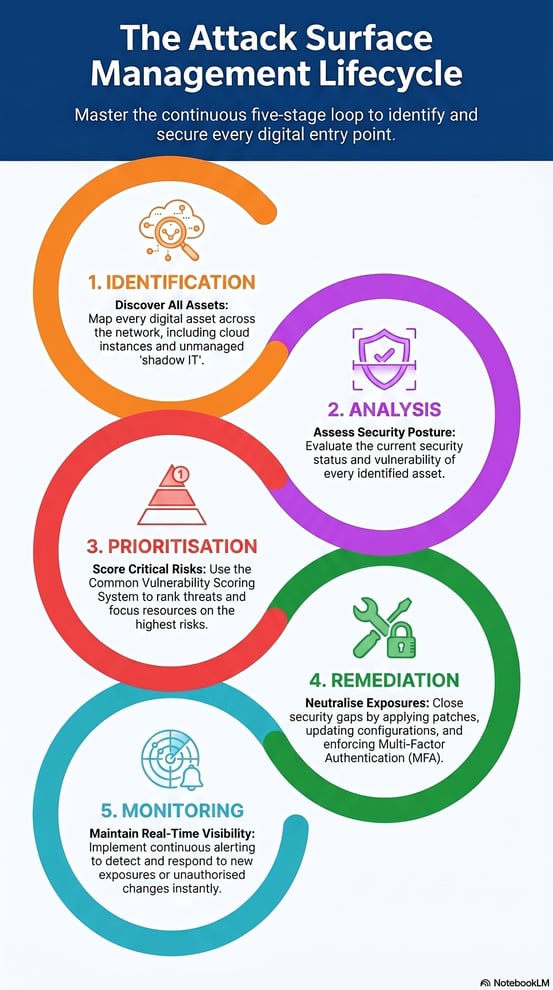
To counter these threats, organisations must transition to Continuous Threat Exposure Management (CTEM). Successfully managing this risk requires mastering the continuous five-stage loop of the Attack Surface Management (ASM) lifecycle to identify and secure every digital entry point:
- Identification (Discover All Assets): Map every digital asset across the network, including cloud instances and unmanaged "shadow IT".
- Analysis (Assess Security Posture): Evaluate the current security status and vulnerability of every identified asset to spot flaws and misconfigurations.
- Prioritisation (Score Critical Risks): Use the Common Vulnerability Scoring System (CVSS) to rank threats and focus resources on the highest risks.
- Remediation (Neutralise Exposures): Close security gaps by applying patches, updating configurations, and enforcing Multi-Factor Authentication (MFA).
- Monitoring (Maintain Real-Time Visibility): Implement continuous alerting to detect and respond to new exposures or unauthorised changes instantly.
For a deeper understanding of these concepts, readers may consult the section on how threat detection works in our earlier article on the architecture of the defence series.
Strategic Mitigation: Zero Trust and ASM
The failure of traditional security has necessitated a shift toward Zero Trust Architecture (ZTA). Based on the principle of "never trust, always verify", Zero Trust eliminates implicit trust based on network location. Key implementation principles include continuous authentication, least-privilege access, and micro-segmentation to prevent lateral movement.
Education as a Strategic Pillar
South Africa faces a significant share of the global shortfall of 3.4 million cybersecurity professionals. The Central University of Technology (CUT) offers a Postgraduate Diploma in Information Technology to bridge this gap.
This NQF Level 8 qualification focuses on workplace-ready applications. The curriculum includes specialised modules such as Advanced Information Security, Ethical Hacking, and Introduction to Cloud Computing Platforms. Delivered fully online, the PDIT prepares graduates for leadership roles like Cybersecurity Specialist or Technology Solutions Architect.
FAQs
1. Why is the attack surface expanding so rapidly in South Africa?
Expansion of the attack surface is driven by cloud migration, the permanence of hybrid work, and the adoption of IoT in heavy industry. These factors move data outside traditional "walls", creating new, unmanaged entry points.
2. What is the difference between an attack surface and an attack vector?
The attack surface is the total set of all possible entry points, while an attack vector is the specific method an attacker uses to exploit one of those points. For example, a phishing email could be an attack vector for gaining access, using email as the entry point.
3. How does Zero Trust help manage a distributed workforce?
Zero Trust assumes the network is compromised and requires every access request to be continuously verified based on user identity and device health. Similar to partitions in a ship’s hull that prevent it from sinking, this means that even if a hacker breaches the perimeter, they cannot easily move around the network.
4. Why are cloud misconfigurations a major risk?
In complex hybrid environments, human error often leads to "permission drift" or unmonitored APIs. These misconfigurations are often easier for attackers to exploit than writing custom malware.
5. What is Continuous Threat Exposure Management (CTEM)?
CTEM is a strategic approach that replaces periodic scans with continuous monitoring and prioritises risks based on their likelihood of exploitation by real-world attackers.