0800 233 724 (toll-free)
 enquiries@online.cut.ac.za


Service-Oriented Architecture (SOA) offers organisations the flexibility to customise their digital infrastructure with modular, interoperable services. These benefits do, however, come with challenges and risks. As these architectures expand across borders, the complexity of securing them increases, particularly regarding vendor lock-in and data sovereignty.
SOA adoption is a strategic response to the expanding attack surface in a connected economy. Enterprises no longer operate within a single "castle-and-moat" perimeter; instead, they exist in a dispersed ecosystem where identity and data are scattered across cloud and on-premise environments. Understanding how these choices influence modern cybersecurity architecture is especially important within South Africa, where data networks are subject to new legislation governing the handling of private data.
Deconstructing Vendor Lock-In: Technical and Operational Hurdles
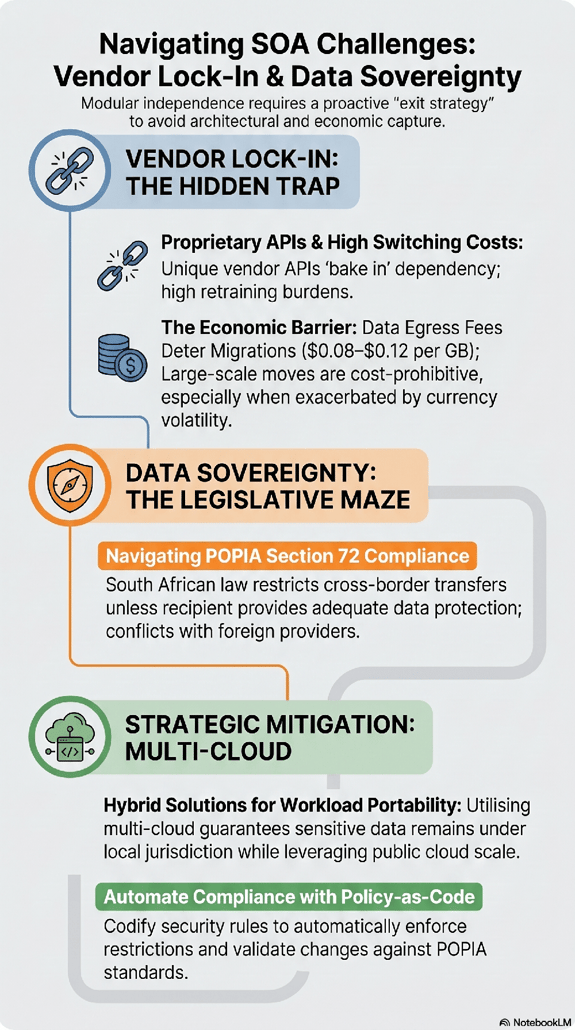
Vendor lock-in occurs when switching costs or disruptions make an organisation essentially forced to continue using a specific provider. In SOA, this dependency is often intentionally "baked in" by vendors through proprietary APIs, unique data storage formats and bespoke management tools. Cloud storage vendors also charge data egress fees to migrate data to another provider, further adding to the financial burden of changing vendors.
Architectural Capture and Operational Burden
Proprietary managed services, such as serverless computing or unique AI tools, offer immediate productivity but often expose APIs not supported elsewhere, tightly coupling application code to a specific vendor. Furthermore, the "portability problem" extends to metadata; if routing and security policies are defined within a vendor-specific layer, moving the service requires rebuilding the entire governance framework.
Operational lock-in is equally critical. As teams invest thousands of hours into mastering specific platforms, the organisation becomes bound by its own institutional expertise. Transitioning to a new provider requires complete workforce retraining, a massive hidden cost that further deters organisations from making a switch.
Economic Impact and Infrastructure Fragility
For South African enterprises, financial implications are exacerbated by currency volatility and infrastructure limitations. Global cloud providers typically bill in US dollars, exposing local firms to annual currency fluctuations.
Another potent lock-in mechanism is data egress fees, which vendors charge users to move data out of a cloud environment. While these fees are relatively modest, with AWS charging between $0.08 and $0.12 per GB, they can add up quickly to make large-scale migrations of tens of terabytes cost-prohibitive. Additionally, reliance on international data centres introduces latency and connectivity risks. In 2024, submarine cable failures left many businesses that were locked into EU or US data centres completely offline, while those using hybrid models with local service endpoints maintained continuity.
Data Sovereignty: The Legislative Maze
Data sovereignty is the principle that data is subject to the laws of the country where it is stored and it has become a boardroom priority in South Africa. The Protection of Personal Information Act (POPIA) mandates strict controls on cross-border data transfers.
Section 72 of POPIA prohibits the transfer of personal information to a foreign country unless the recipient provides an adequate level of protection. This creates a conflict with US-based providers, where US authorities are authorised to compel data disclosure regardless of physical storage location. Non-compliance with POPIA can result in fines of up to R10 million or criminal charges.
Technical Mitigation: Multi-Cloud and Hybrid Solutions
To reclaim independence, organisations are turning to multi-cloud and hybrid architectures to ensure workload portability. However, multi-cloud environments are complex, and security teams face more daily alerts than in single-cloud deployments.
The management of a multi-cloud environment can be greatly improved by using Policy-as-Code (PaC) to automatically enforce security rules across all environments. PaC is the methodology of defining, managing, and enforcing security, compliance, and operational rules through machine-readable code rather than static documents or manual checklists. By codifying these rules, an organisation can automate its governance, ensuring that every architectural change is validated against established standards before deployment.
South African organisations can use PaC to enforce POPIA requirements by ensuring that sensitive workloads are physically and logically restricted to specific jurisdictions.
Advancing Expertise with CUT
Navigating these complexities requires professionals who understand both technical engineering and legislative governance. The Central University of Technology (CUT) addresses this through its Postgraduate Diploma in Information Technology.
This fully online, NQF Level 8 programme prepares graduates for leadership roles in the evolving tech landscape. Key modules include:
- Advanced Information Security: Focuses on enhancing cybersecurity and IT governance.
- Ethical Hacking: Provides tools to identify vulnerabilities in complex architectures.
- Cloud Computing Platforms: Establishes the foundation for informed vendor and hybrid-cloud decisions.
- Advanced Software Development: Teaches modular development to resist vendor lock-in.
Conclusion
SOA offers the agility needed for modern innovation, but South African enterprises must manage the associated risks of lock-in and data sovereignty. By adopting hybrid strategies and leveraging local infrastructure, businesses can build a first line of digital defence that is both resilient and compliant.
FAQs: SOA Challenges
1. What are the main indicators of vendor lock-in in an SOA?
Indicators to watch out for when comparing vendors include the use of proprietary APIs, unique data storage formats and high data egress fees. Operational indicators include a workforce trained exclusively in one vendor's tools.
2. How does POPIA impact multi-cloud design?
POPIA requires clear visibility into data location and protection. Those in charge of data networks must ensure personal information is only transferred to jurisdictions with adequate protections and maintain written contracts with all data operators.
3. Can a hybrid cloud approach mitigate sovereignty issues?
Yes. By keeping sensitive or regulated data on private or on-premise servers, organisations maintain national jurisdiction and control, while using public clouds for non-sensitive workloads.
4. Why are data egress fees a threat to African businesses?
They create a financial barrier to migration, often billed in US dollars. This subjects businesses to local currency volatility and can make moving to a more compliant provider cost-prohibitive.
5. What technical skills are needed for managing data sovereignty?
Critical skills include proficiency in containerisation, multi-cloud identity and access management (IAM), and Policy-as-Code for automated compliance.