0800 233 724 (toll-free)
 enquiries@online.cut.ac.za


Recent and ongoing advances in mobile connectivity and global integration can be seen as a double-edged sword. While this has fostered innovation and opened up immense opportunities, it has also vastly increased the vulnerability of networks to advanced cyber attacks. Traditional perimeter-based security is now obsolete due to the dissolution of the network boundary. As organisations transition to distributed, cloud-native environments, the architecture of defence must evolve. Service-Oriented Architecture (SOA) provides the modularity required to protect data in motion, in use, and at rest.
Historically, IT systems were monolithic, where changes to one component necessitated a complete system overhaul. This rigidity extended to security, which was often merely "bolted on". Today, the attack surface has expanded exponentially. To mitigate risks, the industry has turned toward SOA, an approach that decomposes applications into independent units. By decoupling functions, SOA-based cybersecurity system design allows for resilient, automated protection that evolves as rapidly as the threats it counters.
The Evolution toward Modularity
Enterprise computing has moved from centralised mainframes to ubiquitous cloud infrastructure. In early years gone by, security meant physical barriers. However, the shift toward a hyper-connected economy rendered hardware middleboxes insufficient. As detailed in our previous article on the architecture of cybersecurity, cloud-native security is a direct response to the sophistication of Advanced Persistent Threats (APTs).
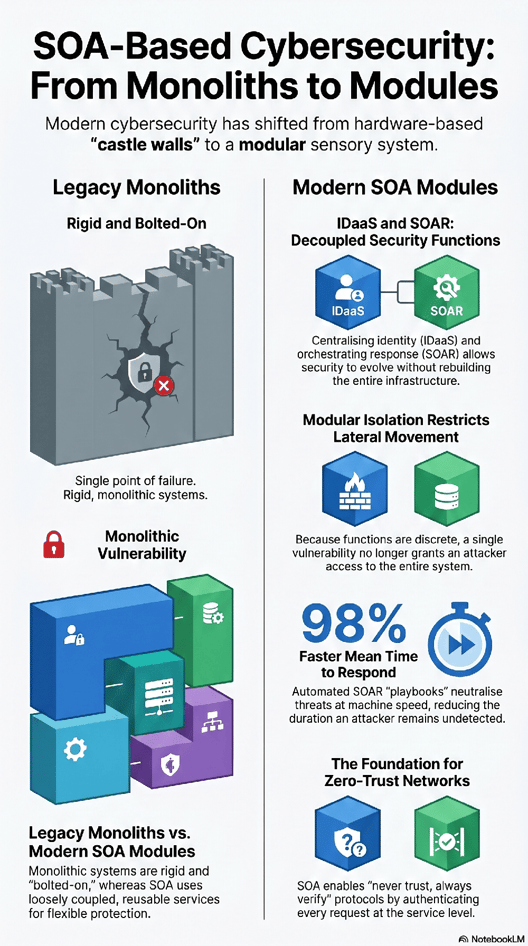
So, what does SOA stand for? Service-Oriented Architecture (SOA) is where applications are built as a collection of loosely coupled, reusable services. Unlike monolithic designs, SOA organises software into discrete modules communicating through standard protocols like REST or SOAP. This modularity limits lateral movement by isolating functions; a single vulnerability no longer grants access to the entire system.
SOA-Based Cybersecurity System Design
In an SOA-enabled environment, critical defensive functions are decoupled from the applications they protect, leading to "security-as-a-service".
Identity and Automated Response
Centralising authentication through Identity as a Service (IDaaS) allows organisations to enforce Identity and Access Management (IAM) across the entire network. This is an important factor in setting up to Zero-Trust microsegmentation, which assumes no user is trusted by default.
Furthermore, Security orchestration, automation and response (SOAR) systems act as conductors, triggering automated "playbooks" to contain breaches. This reduces "dwell time", which is the duration an attacker remains undetected. By speeding up response times, automated systems limit the amount of potential damage that an attacker can inflict.
The South African Cybersecurity Context
South Africa is a prime target for international cybercrime due to its sophisticated IT infrastructure. In 2024, nearly six out of ten South African businesses experienced an attack. The economic impact is staggering, costing the economy approximately R2.2 billion annually.
Ransomware in particular has emerged as a dominant threat in South Africa, with criminals employing "double-extortion" tactics. Phishing remains the primary entry point, exploiting unpatched vulnerabilities. For local SMEs, the "as-a-service" model provided by SOA is vital, allowing them to leverage SOC-as-a-service without the cost of a full internal team.
Legally, the Cybercrimes Act No. 19 of 2020 (promulgated Dec 2021) criminalises hacking and data interception. SOA's modularity helps organisations manage access controls and maintain logs required for legal compliance.
Academic Excellence: CUT’s PGDip in IT
The demand for highly skilled IT professionals continues to grow. The Central University of Technology (CUT) addresses this through its Postgraduate Diploma in Information Technology. This NQF Level 8 programme is designed for professionals seeking to advance expertise in systems analysis and cybersecurity.
Delivered fully online, the diploma enables students to balance careers while mastering current practices. Key modules include:
- Advanced Information Security: Implementing strategies to enhance cyber measures.
- Advanced Software Development: Building scalable software.
- Ethical Hacking: Identifying vulnerabilities in threat detection systems.
Future Horizons: AI and Quantum Resilience
The future of SOA in cybersecurity is linked to AI. Machine learning established baselines for behavioural detection, identifying threats that signature-based systems miss. Furthermore, as quantum computing threatens modern encryption, SOA’s modularity allows for "cryptographic agility", which is the ability to swap out encryption modules for quantum-resistant versions without rebuilding entire infrastructures.
Conclusion
For South African institutions, the shift to SOA is a strategic necessity. By decommissioning monolithic legacy systems and adopting a Zero-Trust security architecture, businesses can achieve long-term resilience. Studying advanced qualifications like CUT's Postgraduate Diploma in Information Technology ensures you will have the scarce skills needed to secure the digital economy against the sophisticated threats of tomorrow.
FAQs: Service-Oriented Architecture
1. How does SOA improve incident response speed?
SOA enables automated alerting. When a threat is detected, it triggers other services (like firewalls) instantly, reducing the time an attacker has to cause damage.
2. What is the difference between SOA and microservices in security?
SOA often centralises communication between all the separate systems through a central software system called an Enterprise Service Bus for consistent governance. Microservices are more granular and can lead to "service sprawl", requiring complex authentication.
3. Why does modularity stop lateral movement?
In a monolithic system, entry often grants total access. In an SOA-based cybersecurity system design, services are isolated with independent controls, forcing attackers to compromise each module individually.
4. How do small South African businesses benefit?
SMEs can subscribe to modular "as-a-service" options like identity-as-a-service, accessing top-tier security without massive capital investment.
5. What is the role of "discoverability" in security?
Discoverability ensures all active services are catalogued. This prevents "shadow IT", unmonitored assets that often become entry points for unauthorised activity.