0800 233 724 (toll-free)
 enquiries@online.cut.ac.za


South Africa’s rapidly evolving digital landscape has moved cybersecurity from a technical niche to a cornerstone of national security and economic resilience. As digital transformation accelerates, South Africa has unfortunately emerged as a primary target, reportedly facing the third-highest incidence of cyberattacks globally. This environment demands that public and private institutions move beyond reactive measures toward structured, framework-based defences to protect digital assets and maintain stakeholder trust.
For IT professionals tasked with leading these initiatives, the Postgraduate Diploma in Information Technology at the Central University of Technology (CUT) offers a rigorous academic pathway. This NQF Level 8 qualification equips graduates with the intellectual independence to implement complex governance and security measures through modules such as Advanced Information Systems Security and IT Governance and Compliance.
Governance and Policy in Security
The foundation of any resilient cybersecurity programme is governance within cybersecurity system architecture. Governance serves as the "architectural discipline" that aligns security objectives with organisational goals, ensuring that high-level decision-making is enforced through technical controls and regular audits.
Effective governance shifts the responsibility of security from purely technical staff to executive leadership. In South Africa, this shift is reinforced by the King V Code, which positions cybersecurity as a central board responsibility. Academic training at CUT specifically addresses this through its focus on research methodology and advanced projects, allowing students to bridge the gap between technical operations and strategic oversight.
Comparative Analysis of Global Frameworks
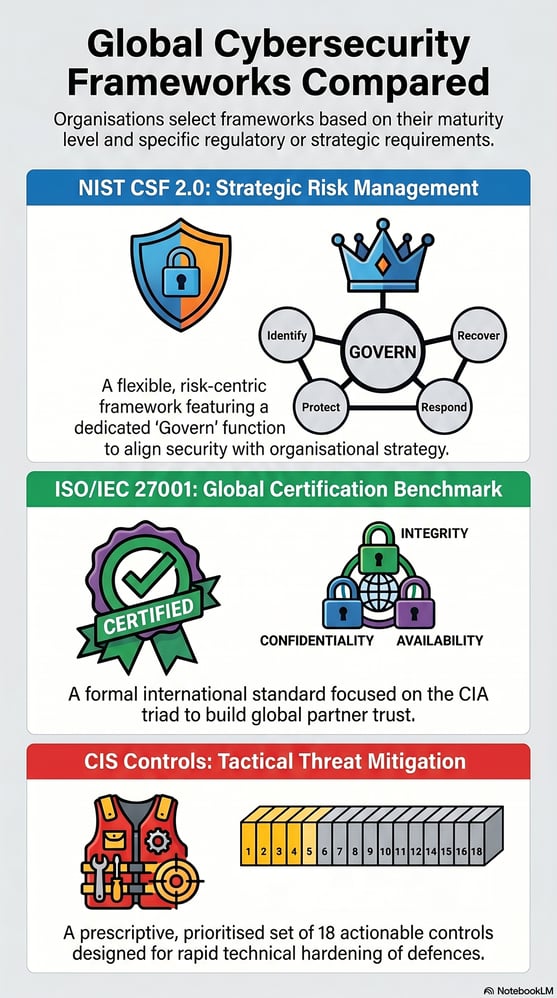
Organisations typically select frameworks based on their maturity level and regulatory requirements. The three most prevalent frameworks - NIST, ISO/IEC 27001, and CIS Controls - offer complementary strengths.
NIST Cybersecurity Framework (CSF) 2.0
The NIST CSF 2.0 is a flexible, risk-centric framework widely used for strategic planning and communicating cyber risk to executive leadership. Version 2.0 introduced a dedicated "Govern" function, emphasising that security is an organisational strategy involving policy and risk management rather than just an IT function. Because it is non-prescriptive and free to access, it is ideal for organisations seeking a scalable approach that maps easily to other international standards.
ISO/IEC 27001: The Global ISMS Benchmark
ISO/IEC 27001 is an international standard that establishes and continually improves an Information Security Management System. Unlike many other frameworks, it offers a formal certification process through third-party audits, which is often a prerequisite for South African firms seeking to build trust with global partners or secure government tenders. It ensures the confidentiality, integrity and availability of data across all departments through a holistic "CIA triad" approach.
CIS Critical Security Controls
The CIS Critical Security Controls provide a tactical, prioritised set of 18 actionable security controls to mitigate the most serious cyber threats. While NIST and ISO are broader, CIS is highly prescriptive, offering specific implementation steps for securing systems. This makes it an excellent starting point for South African SMEs to bolster their cybersecurity architecture.
|
Framework |
Primary Focus |
Key Advantage |
Implementation Context |
|
NIST CSF 2.0 |
Strategic Risk Management |
Highly flexible; adds a "Govern" function. |
Strategic planning for all organisational sizes. |
|
ISO/IEC 27001 |
Information Security Management |
Globally recognised, certifiable standard. |
Building international trust and meeting contract mandates. |
|
CIS Controls |
Tactical Threat Mitigation |
Prioritised, actionable technical steps. |
Rapidly hardening defences, particularly for SMEs. |
The CUT Postgraduate Diploma in Information Technology curriculum integrates these standards into its teaching, particularly in the Advanced Information Security and Ethical Hacking modules, where students learn to apply these controls within the South African context.
Regulatory Compliance: POPIA and the Joint Standard 2
The South African regulatory environment has matured significantly with the implementation of the Protection of Personal Information Act (POPIA). POPIA mandates that organisations implement "appropriate and reasonable" technical and organisational measures to prevent data loss or unauthorised access.
In the financial sector, the introduction of the Joint Standard 2 (JS2) of 2024 requires far more robust mandated security within the financial sector. Effective as of 1 June 2025, the JS2 requires financial institutions to establish comprehensive cybersecurity strategies and report significant incidents within 24 hours. This heightened regulatory pressure underscores the need for qualified professionals who can manage the intersection of law and technology, a core theme of the CUT PDIT programme.
Security Maturity Assessment: Measuring Resilience
To ensure long-term stability, organisations must conduct regular security maturity assessments. These assessments evaluate current capabilities against a target state, identifying gaps in technical controls and incident response protocols.
Organisations can utilise tools provided by the CSIR to benchmark their compliance and cloud readiness. Mastering these assessments is a high-level skill demand that is addressed in the CUT curriculum, where students are trained to conduct systematic surveys of thinking and research methods to solve real-world security challenges.
Conclusion: Developing the Next Generation of IT Leaders
Frameworks and regulations provide the blueprint, but skilled human capital is required for successful implementation. The Central University of Technology's fully online Postgraduate Diploma in Information Technology provides the academic foundation to navigate this landscape. By blending theoretical engagement with practical modules like Cloud Computing and Advanced Research Projects, CUT ensures its graduates are ready to lead South Africa's digital future with confidence.
FAQs: Frameworks and Compliance
1. Which cybersecurity framework is most suitable for a South African organisation?
The choice depends on your objectives. ISO 27001 is best for those needing international certification and stakeholder trust. The NIST CSF is ideal for strategic risk management across diverse departments, while CIS Controls offer a practical, "low-barrier" starting point for immediate technical hardening.
2. Is ISO 27001 certification a legal requirement in South Africa?
ISO 27001 is not universally mandated by law, but it is often required in service level agreements (SLAs) or government tenders. Furthermore, its principles are widely considered the benchmark for achieving compliance with POPIA's technical safeguard requirements.
3. How does the NIST CSF 2.0 differ from earlier versions?
The 2.0 version introduced a dedicated "Govern" function. This explicitly emphasises that cybersecurity is an organisational strategy involving risk management, policies, and executive-level oversight, rather than just an isolated technical operation.
4. What is a "security maturity assessment"?
A security maturity assessment is a systematic review that measures an organisation's security processes and technical controls against an established framework (like NIST or ISO). It helps identify critical gaps and provides a roadmap for improving cyber resilience.
5. Can an organisation implement multiple frameworks at once?
Yes. Many organisations use the NIST CSF for high-level strategy and reporting, ISO 27001 for governance and certification, and CIS Controls for specific, daily technical configurations. These frameworks are highly compatible and often map directly to one another.