South Africa currently stands at the epicentre of a regional cybersecurity crisis. According to Interpol, the country recorded 17,849 ransomware detections in 2024, the highest volume on the continent. The ESET Threat Report further highlights this exposure, noting that South Africa accounts for 40% of all ransomware attacks and nearly 35% of infostealer incidents across Africa. As organisations grapple with an expanding attack surface in a connected economy, the traditional model of reactive IT support has proven insufficient against sophisticated, AI-driven threats. To counter this, businesses are increasingly centralising their digital defences through a Security Operations Centre.
What is an SOC?
A Security Operations Centre (SOC) is a centralised function or team responsible for continuously monitoring, detecting and responding to cybersecurity threats. Unlike a standard IT help desk, the SOC is purely adversarial-focused. Its primary mission is to maintain high-fidelity visibility across the enterprise and minimise the Mean Time to Respond (MTTR) to incidents.
In a modern security management and governance framework, the SOC acts as the nerve centre, integrating people, processes and threat detection technologies to safeguard digital assets.
Comparing Security Operations Centres and SOC-as-a-Service
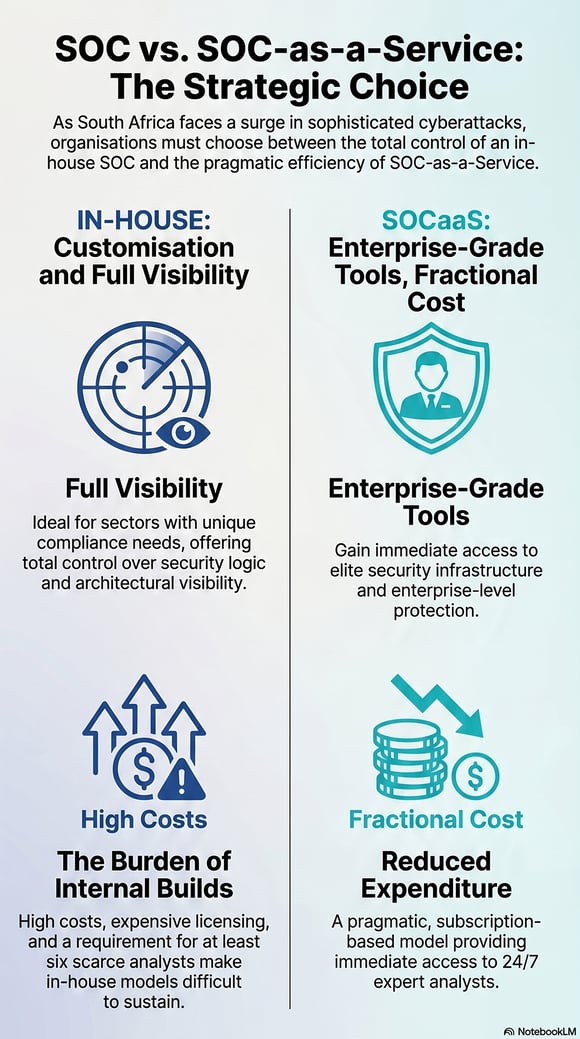
The most significant strategic decision for a Chief Information Security Officer (CISO) is choosing between setting up an in-house security operations centre and SOC-as-a-Service.
- The In-House SOC: This model provides full visibility and customisation of security logic, which is critical for sectors such as banking and government with unique compliance needs. However, the cost is substantial. Industry analysis suggests that a "minimum viable" in-house SOC requires at least six analysts to provide genuine 24/7 coverage. The combination of scarce skills, high labour costs and expensive licensing fees can quickly drive up costs, limiting the viability of an in-house SOC to the largest of companies.
- SOC-as-a-Service (SOCaaS): For many mid-market organisations, the SOC-as-a-Service model offers a more pragmatic path. This subscription-based model provides immediate access to enterprise-grade tools and expert analysts at a fraction of the cost of an internal build.
South African Challenges: POPIA and the Skills Gap
The drive toward centralised monitoring is not merely a technical choice but a regulatory necessity. Under the Protection of Personal Information Act (POPIA), organisations must prove they have implemented "appropriate technical and organisational measures" to secure personal data. A failure to do so can result in fines of up to R10 million and potentially catastrophic reputational damage.
Furthermore, the Human Science Research Council reports that 63% of cybersecurity roles in the country are currently unfilled. This chronic shortage of human capital makes it difficult to maintain 24/7 monitoring and incident response lifecycle internally.
Preparing the Next Generation of Leaders
Bridging this gap requires a new calibre of IT professional who understands both the technical and strategic layers of security. The Central University of Technology (CUT) addresses this national challenge through its Postgraduate Diploma in Information Technology.
This 100% online programme is designed for working professionals and offers specialised modules such as Advanced Information Security and Ethical Hacking. The curriculum demands high-level theoretical engagement and prepares graduates to design and build security operation centres that can withstand the evolving threats of the digital economy.
By balancing rigorous academic theory with practical application, the PDIT ensures that South African IT leaders can make informed decisions about whether to build or buy security operations, ultimately fostering long-term organisational resilience.
FAQs: Security Operations Centres
1. What is the difference between an SOC and a Network Operations Centre (NOC)?
A NOC focuses on network performance, availability, and uptime to ensure the network operates smoothly. Conversely, an SOC is adversarial-focused; its mission is to detect and respond to malicious intent and security breaches.
2. How does an SOC support POPIA compliance?
POPIA requires "continuous monitoring" and auditable logs to prove data integrity. An SOC provides the monitoring-as-a-service and reporting frameworks necessary to demonstrate compliance during a regulatory audit or following a breach notification.
3. Does SOC-as-a-Service handle actual incident containment?
Most mature SOCaaS providers include incident response capabilities, such as isolating compromised endpoints or disabling accounts. However, the specific level of response is usually defined in a Service Level Agreement (SLA).
4. What is "alert fatigue," and how do modern SOCs manage it?
Alert fatigue occurs when analysts are overwhelmed by a high volume of false positives. Modern SOCs use automated alerting and prioritisation and AI-driven triage to filter noise, allowing human experts to focus on "true positive" threats.
5. Why is "Mean Time to Respond" (MTTR) the most critical SOC metric?
Mean Time to Respond (MTTR) measures the time it takes to contain a threat after detection. In an environment where attackers can move laterally through a network in under 30 minutes, a low MTTR is the primary indicator of an effective incident response lifecycle.