
Despite its relatively modest presence on the global stage, South Africa has the dubious honour of being a world leader for digital crime. As the continent's most industrialised economy, the country has the third-highest incidence of cyberattacks globally. This increase in attacks, together with the shift towards remote work and mobile connectivity, means that traditional perimeter-based security is failing.
In this article, we will discuss how organisations are shifting toward an active architecture of defence where security is delivered via cloud-native, service-oriented models. We will also touch on how CUT’s Postgraduate Diploma in Information Technology provides the skills needed to implement these services.
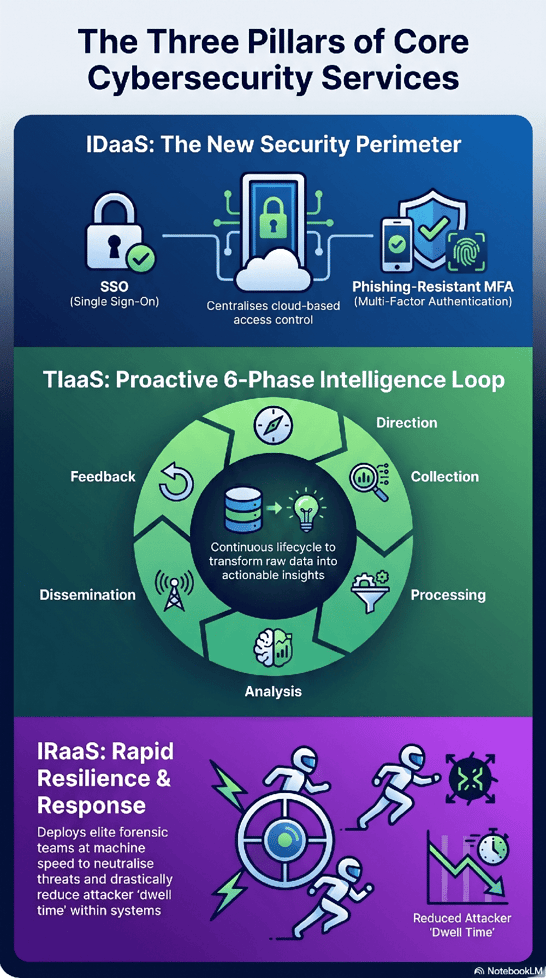
Identity as a Service (IDaaS): The New Perimeter
With the rise of remote work, identity has replaced the physical office as the primary security boundary. Organisations now need to manage access across dispersed ecosystems that extend well beyond their physical confines.
Identity-as-a-service is a cloud-based subscription model for Identity and Access Management (IAM). By leveraging third-party providers to host authentication infrastructure, organisations ensure that only verified users gain access to specific resources. In South Africa, this is also a vital component of compliance with the Protection of Personal Information Act (POPIA), which mandates strict access controls for sensitive data.
Modern IDaaS platforms implement industry-standard protocols to facilitate secure Single Sign-On (SSO). Local innovations like the VeristicPrint biometric system from the Council for Scientific and Industrial Research (CSIR) offer a cost-effective way to implement biometric identification through conventional smart phones, webcams and digital cameras.
The Threat Intelligence Lifecycle: Proactive Defence
To counter emerging threats, organisations must transition from reactive to proactive stances. This is achieved through threat-intelligence-as-a-service, which connects a local network to a global repository of security data. Central to this is the threat intelligence lifecycle, a continuous six-phase process that transforms raw data into actionable insights:
- Direction: Setting goals and identifying critical assets.
- Collection: Gathering data from multiple sources including internal logs, threat-intel feeds and open-source intelligence (OSINT).
- Processing: Structuring raw data into usable formats.
- Analysis: Human-led extraction of patterns, often using MITRE ATT&CK mapping to understand adversary tactics.
- Dissemination: Delivering tailored intelligence to technical teams and executives.
- Feedback: Evaluating the cycle’s effectiveness to refine future requirements.
By utilising early warning systems, South African firms can receive patches for new threats from across the world before they reach local shores.
Incident Response as a Service (IRaaS): Ensuring Resilience
Despite robust defences, breaches are often inevitable. Incident-response-as-a-service provides a rapid, expert force to contain threats and restore operations. Similar to the way many South African homes pay for armed response and security services without having to house and employ their own small army, IRaas allows Small and medium enterprises (SMEs) access to a full-time team of elite forensic investigators, negotiators and malware reverse-engineers when a crisis occurs.
The incident response (IR) lifecycle focuses on reducing "dwell time", which is the duration an attacker remains in a system. Rapid containment at "machine speed" is essential, as data exfiltration can occur far more quickly than humans can react. Post-incident, monitoring-as-a-service and compliance-as-a-service modules ensure that vulnerabilities are permanently sealed.
Governance and the Skills Gap
In South Africa, the Information Regulator mandated in April 2025 that all security compromises be reported. This regulatory environment, combined with a recent survey finding that 63% of South African cybersecurity roles are partially or fully vacant, has created an urgent need for qualified professionals.
The Central University of Technology (CUT) addresses this gap through its Postgraduate Diploma in Information Technology. This NQF Level 8 qualification offers modules directly aligned with these core services, including:
- Advanced Information Security: Deep theoretical engagement with defensive frameworks.
- Ethical Hacking: Preparing students for threat hunting and analysis roles.
- Cloud Computing Platforms: Cloud computing platforms are fundamental for managing modern IDaaS and IRaaS environments.
By blending technical mastery with strategic governance, the CUT Postgraduate Diploma in Information Technology empowers the next generation of IT leaders to orchestrate an effective defence architecture for the South African economy.
FAQs: Core Cybersecurity Services
1 What is Identity as a Service (IDaaS)?
Identity as a Service (IDaaS) is a cloud-hosted subscription model that provides organisations with identity and access management (IAM) capabilities. Rather than investing in the setup and maintenance of complex on-premises authentication infrastructure, businesses can use third-party providers to deliver identity services, such as single sign-on (SSO) and multi-factor authentication (MFA). Outsourcing this security function provides companies with scalable, cost-effective protection.
2. How does IDaaS assist with POPIA compliance?
IDaaS provides the necessary security safeguards required by POPIA. It centralises access management and enforces Multi-Factor Authentication (MFA), ensuring personal information is only accessed by authorised parties. Additionally, its logging capabilities provide the audit trails required for mandatory breach reporting to the Information Regulator.
3. What is the difference between threat data and threat intelligence?
Threat data consists of raw, unprocessed indicators like IP addresses or file hashes. Threat intelligence is more structured information produced through the threat intelligence lifecycle. Threat intelligence is built up from threat data that has been analysed to provide context on where and how the attack originated, allowing for proactive defensive adjustments.
4. Why should South African SMEs consider IRaaS?
SMEs are often disproportionately affected by cyberattacks due to limited internal expertise. IRaaS offers a scalable, subscription-based model that provides 24/7 access to specialised forensic tools and experts. This minimises downtime and recovery costs, which often far exceed the cost of the service retainer.
5. How does the CUT PDIT prepare students for cybersecurity careers?
The fully online Postgraduate Diploma in Information Technology programme provides high-level theoretical knowledge and practical skills through modules like Ethical Hacking and Advanced Information Security. As a fully online NQF Level 8 qualification, it allows working professionals to specialise in cloud-native security and governance, directly addressing the regional skills shortage.