
The world of cybersecurity is an ongoing arms race. Traditional security systems based on static, perimeter-based defence, have been rendered obsolete by the agility of modern adversaries. In this environment, organisations need to keep up with the evolution of cybersecurity systems. In this article, we will discuss the most recent developments in cybersecurity, with specific reference to the skills taught in CUT’s fully online Postgraduate Diploma in Information Technology.
The African Threat Landscape in Flux
The African continent stands at a critical juncture. As connectivity deepens, the complexity of threats is growing exponentially. According to a 2025 Interpol report, malware, online scams, and business email compromises dominate the environment. Between 2019 and 2025, cyber incidents across the continent resulted in estimated financial losses exceeding $3 billion.
These losses are concentrated in critical sectors such as finance, healthcare, and government, where operational disruptions have systemic ripple effects. In South Africa specifically, the expanding attack surface of the modern economy has made the country a primary hotspot for ransomware detections.
The Industrialisation of Ransomware and APTs
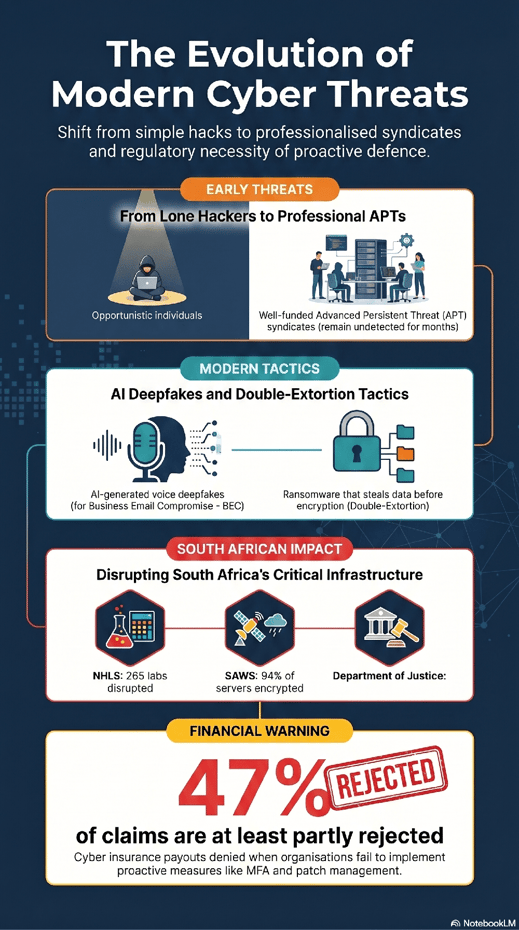
The primary driver for security evolution is the professionalisation of cybercriminal syndicates. We have moved beyond opportunistic hackers into an age defined by Advanced Persistent Threats (APTs). These actors infiltrate networks and remain undetected for months, bypassing traditional controls using "zero-day" techniques.
South Africa has witnessed several high-profile incidents that underscore this vulnerability:
- National Health Laboratory Service (NHLS): A June 2024 ransomware attack forced 265 laboratories to revert to manual processes, disrupting pathology services for 80% of the population.
- South African Weather Service (SAWS): In a January 2025 data breach, the RansomHub gang encrypted 94% of the service's servers, taking national forecasting systems offline.
- Department of Justice: A 2021 ransomware attack was exacerbated by a failure to renew essential security licenses, highlighting gaps in security management and governance.
Transitioning to Proactive Defence
The inadequacy of reactive models has driven a shift toward proactive security. While reactive models often result in "alert fatigue", proactive strategies focus on identifying threats before they escalate.
Central to this shift is the integration of Artificial Intelligence (AI) and Machine Learning (ML). Modern systems use AI to identify patterns indicative of potential breaches, favouring behavioural detection over signature-based detection. Furthermore, technologies such as Endpoint Detection and Response (EDR) and Security Information and Event Management (SIEM) provide the visibility required to secure an environment where the "network perimeter" has essentially dissolved.
Compliance and the Regulatory Mandate
Cybersecurity is no longer solely a technical issue; it is a legal requirement for companies and their management. In South Africa, the Information Regulator enforces the Protection of Personal Information Act (POPIA), and companies are legally obliged to report any data breaches. In the 2024/25 financial year, 2,374 security compromise incidents were reported to the regulator.
Compliance is also a prerequisite for financial stability. Research indicates that 47% of South African organisations with cyber insurance had parts of their ransomware claims denied because they failed to meet specific technical requirements, such as Multi-Factor Authentication (MFA) or proper patch management. This highlights the increasing need for organisations to adopt a risk-based security strategy.
Addressing the Skills Deficit through Advanced Education
The most significant bottleneck in this evolution is the critical shortage of skilled professionals. In South Africa, 63% of cybersecurity roles remain partially or fully unfilled. Employers frequently report that higher education often fails to prepare graduates for the "hard technical and data skills" required in modern security operation centres.
To address this gap, the Postgraduate Diploma in Information Technology (PDIT) offered by the Central University of Technology (CUT) provides systematic coverage of current research and practice. This NQF Level 8 qualification is designed for professionals seeking the intellectual independence required for senior roles.
The curriculum is directly aligned with modern security needs through modules such as:
- Advanced Information Security: Focusing on risk mitigation and security policy design.
- Ethical Hacking: Providing hands-on skills to identify vulnerabilities before they are exploited.
- Introduction to Cloud Computing Platforms (CLD527E): Essential for securing cloud and hybrid architectures.
Delivered 100% online, the PDIT enables working professionals to upskill while managing their careers, which has been reported as a priority for 81% of South African employers.
Conclusion
The evolution from static to proactive cybersecurity is a strategic necessity for African institutions. By combining advanced threat detection with robust academic training, organisations can move from a posture of vulnerability to one of resilience.
FAQs: Evolution of Cybersecurity
1. How has the concept of the "network perimeter" changed?
The rise of cloud computing and remote work has dissolved the traditional "digital wall" around organisations. Security must now be pervasive, focusing on protecting individual data assets and identities regardless of their location on the network.
2. What is the advantage of behavioural detection over traditional methods?
Signature-based detection only identifies known malware patterns. Behavioural detection uses AI to identify suspicious activity, such as unusual data transfers, allowing systems to thwart "zero-day" attacks that lack existing signatures.
3. Why is Business Email Compromise (BEC) increasing in South Africa?
BEC syndicates have become highly professionalised, using AI-generated voice deepfakes to impersonate executives. These attacks are often more damaging than malware because they manipulate legitimate financial workflows.
4. How does POPIA influence cybersecurity investment?
POPIA mandates "appropriate and reasonable" measures to secure personal data. Non-compliance can lead to fines of up to R10 million, underscoring the centrality of security to corporate governance and compliance.
5. What are "double extortion" ransomware attacks?
In double extortion, attackers steal sensitive data before encrypting it. They demand one ransom for decryption and a second to prevent the public release of the stolen data, significantly increasing the pressure on the victim.