0800 233 724 (toll-free)
 enquiries@online.cut.ac.za


South Africa’s digital skills gap remains a significant challenge. As businesses and public institutions accelerate their digital transformation, the demand for highly skilled IT professionals is rising sharply. The Postgraduate Diploma in Information Technology, offered fully online by the Central University of Technology (CUT), is designed to bridge this gap, equipping working professionals with the advanced knowledge required to thrive in this evolving environment.
For those considering this qualification, understanding the entry criteria is the first step toward career advancement. Because this is a postgraduate-level programme, it is structured to build upon existing technical foundations, ensuring that all students are prepared for the academic rigour and strategic focus of the curriculum.
Admission requirements
The primary requirement for entry into the Postgraduate Diploma in Information Technology is an academic foundation that demonstrates your readiness for studies at NQF Level 8.
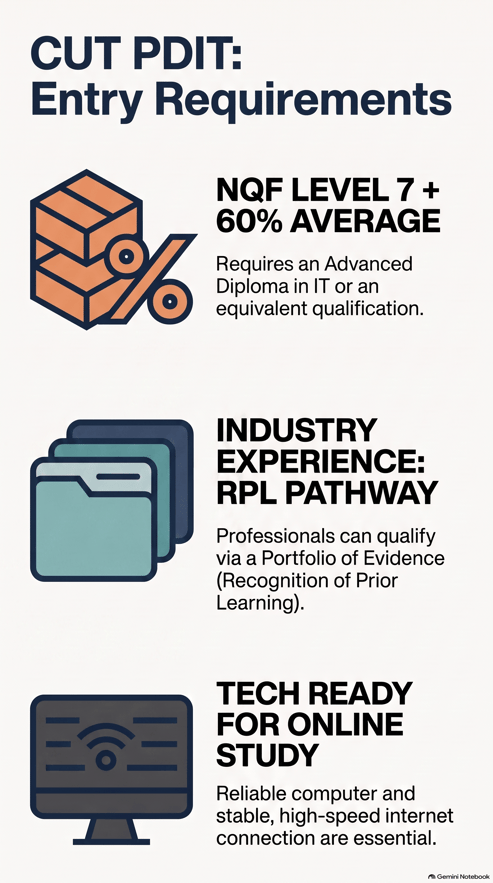
- Academic Qualification: Applicants must have completed an Advanced Diploma in Information Technology or an equivalent qualification at NQF Level 7.
- Academic Performance: A minimum average of 60% in your previous relevant qualification is generally required.
- Work Experience Preferred: This is not a strict requirement for admission, but applicants who are already working in the sector will be at an advantage over those without work experience.
This entry requirement is purposefully set to ensure that candidates possess the necessary baseline knowledge in software development, system architecture and research methodologies to succeed in the programme. By maintaining these standards, the programme ensures that the peer group is well-matched in terms of foundational expertise, fostering a high-quality collaborative learning environment.
Leveraging professional experience through RPL
CUT recognises that academic qualifications are not the only indicator of professional competence. For prospective students who may not meet the formal academic criteria but possess extensive industry knowledge, the university employs a Recognition of Prior Learning (RPL) process.
This pathway is designed for those who have spent significant time in the IT sector and can demonstrate a track record of practical, high-level skill application. Admission via RPL is conducted on an individual basis. To pursue this route, applicants are typically required to submit a comprehensive portfolio of evidence. This documentation must clearly reflect extensive work-based learning, allowing CUT’s RPL committee to assess your experience against the relevant learning outcomes of the programme.
Technical and practical requirements
As this programme is delivered fully online, it provides the flexibility needed by professionals balancing full-time employment with their studies. However, success in a digital learning environment requires reliable access to the necessary tools. To engage with the course material effectively, students will need:
- Reliable Technology: Access to a stable laptop or desktop computer is essential.
- Consistent Connectivity: A reliable, high-speed internet connection to participate in online lectures, access course portals and submit assessments.
- Digital Fluency: A base level of computer literacy to navigate the online learning management system and collaborative tools.
By aligning your professional goals with this advanced qualification, you are positioning yourself to move beyond operational roles and into strategic management and leadership positions within the South African technology landscape.
FAQs
1. What counts as an equivalent qualification to the Advanced Diploma?
An equivalent qualification typically refers to a degree or diploma at NQF Level 7 in an IT-related field. Admissions committees review previous academic records to ensure that the content covered in your previous studies aligns with the foundational requirements for this postgraduate programme.
2. Does my current work experience automatically grant me entry?
Not automatically. While your work experience is highly valued and may be a significant advantage, entry based on experience requires going through the formal Recognition of Prior Learning (RPL) process. This involves submitting a portfolio of evidence, which is then assessed by the faculty to determine if your practical skills meet the necessary academic standard.
3. What documents are needed for my application?
You will need your certified academic records, including your official transcript and certificate for your NQF Level 7 qualification. If you are applying via RPL, you must also prepare a portfolio of evidence detailing your professional experience, which should be aligned with the learning outcomes of the programme.
4. How do I know if my international qualification is valid for admission?
International qualifications must be evaluated to ensure they are comparable to a South African NQF Level 7 qualification. You may be required to have your qualifications assessed by the South African Qualifications Authority (SAQA) to provide a certificate of evaluation, which helps the university determine its alignment with local standards. You can read more about this process on the SAQA website here.
5. Is there a specific deadline for submitting my entry requirements?
The application process operates on specific intake cycles. You should check the current application deadlines on the programme page to ensure your documentation is submitted on time, allowing sufficient space for your application and RPL portfolio (if applicable) to be processed.